

Enabling Interactive 3D Product Experiences on E-Commerce PDPs with Model-Viewer
Introduction
As e-commerce experiences continue to evolve, static product imagery is no longer sufficient for showcasing premium and highly visual products. Customers increasingly expect immersive product interactions that help them better understand a product's form, design, and finer details before making a purchase.
To address this need, we explored integrating 3D product visualization into Product Detail Pages (PDPs).
The objective was simple: enable customers to interact with 3D product models directly on the website while maintaining:
- Fast page performance
- Scalability across large product catalogs
- Seamless integration with existing commerce and content management platforms
- Cross-browser and device compatibility
- Minimal development and maintenance overhead
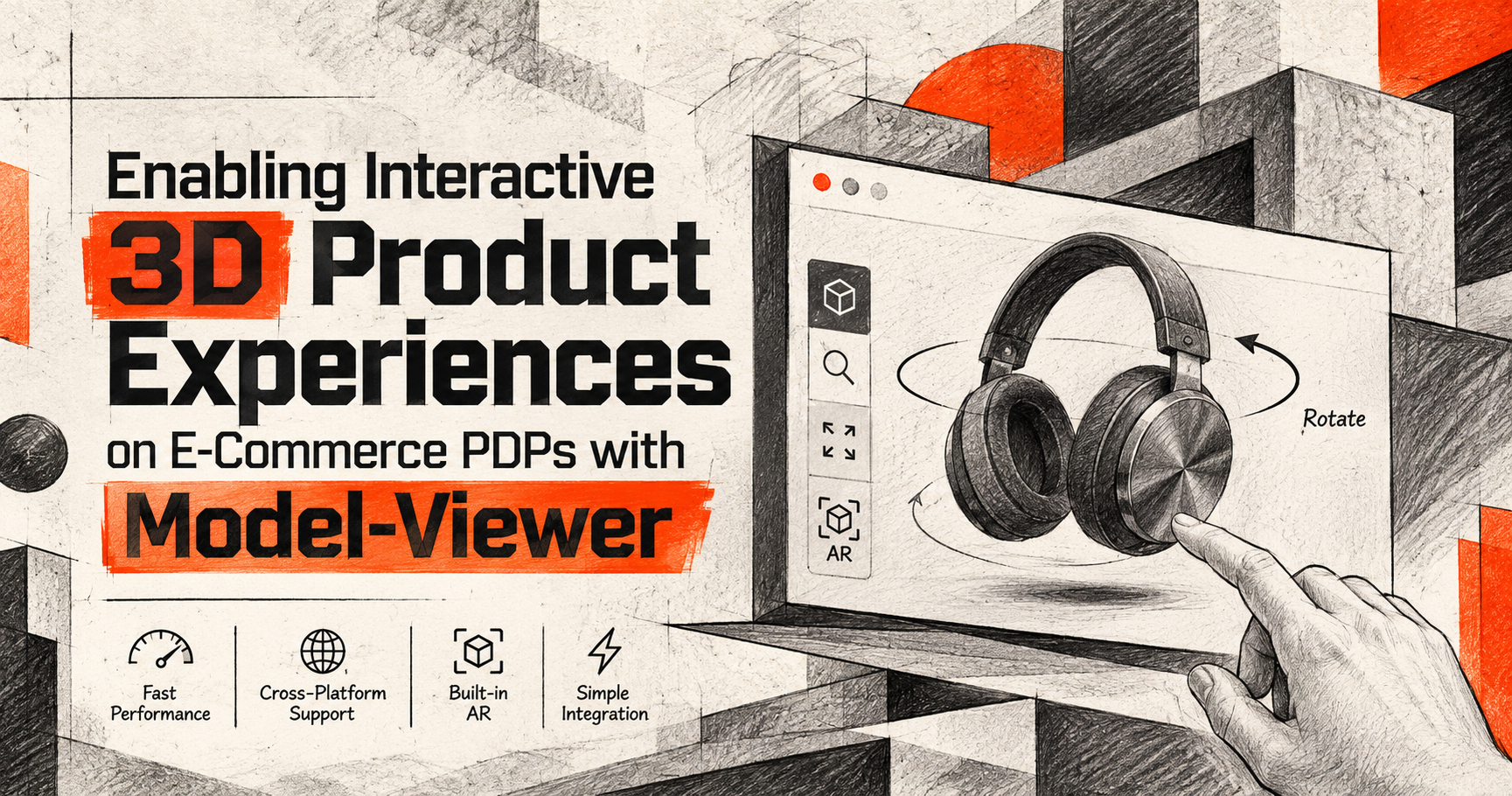
This article explores the available approaches and why Google's <model-viewer> emerged as a suitable solution for this use case.
1. The Business Challenge
Introducing interactive 3D experiences into an existing e-commerce ecosystem comes with several considerations.
Our primary challenges included:
- Page Performance: Maintaining existing page performance and SEO scores while introducing 3D assets.
- Catalog Scalability: Supporting large product catalogs, multiple SKUs, and product variants.
- Cross-Platform Compatibility: Ensuring consistent experiences across browsers, devices, and screen sizes.
- Development Effort: Minimizing implementation complexity and long-term maintenance costs.
- Platform Integration: Integrating with existing systems such as Adobe Experience Manager (AEM) and SAP Hybris.
- Asset Delivery: Efficiently delivering large 3D assets through CDN infrastructure.
The solution needed to fit into the existing architecture rather than introduce an entirely new rendering ecosystem.
2. Evaluating Available Solutions
Before selecting an implementation approach, we evaluated four potential solutions based on their capabilities, implementation complexity, and suitability for e-commerce Product Detail Pages.
Comparison Matrix
| Criteria | AEM Dynamic Media (3D) | Babylon.js | Three.js | Model-Viewer |
|---|---|---|---|---|
| Primary Purpose | Enterprise Asset Delivery | Full 3D Game Engine | Custom 3D Rendering Engine | Simple 3D Model Display |
| Implementation Effort | Medium–High | High | High | Very Low |
| Time to Market | Medium | Slow | Slow | Fast |
| Learning Curve | Medium | Steep | Steep | Minimal |
| PDP Performance | Depends on Setup | Good, but potentially heavy | Good with optimization | Optimized for GLB viewing |
| Bundle Size Impact | External Delivery | Heavy (~1 MB+) | Medium (~150 KB+) | Lightweight integration |
Note: These are indicative qualitative comparisons. Actual performance and bundle-size impact depend on implementation, dependencies, asset complexity, and delivery strategy.
Why Model-Viewer?
After evaluating the alternatives, <model-viewer> stood out because it provides a straightforward way to display interactive 3D models without requiring a custom rendering engine.
Key advantages include:
- Ease of Integration: Simple HTML-based integration with minimal implementation effort.
- Cross-Platform Compatibility: Supports modern browsers and responsive experiences across devices.
- Performance Optimization: Supports features such as lazy loading and optimized model delivery.
- Built-In AR Support: Provides augmented reality capabilities on supported devices.
- Reliability and Low Maintenance: Reduces the need to build and maintain custom rendering logic.
- E-Commerce Suitability: Focuses on displaying and interacting with 3D models, making it a practical fit for PDP experiences.
3. Proposed Solution Architecture
The proposed architecture separates asset management, product references, and frontend rendering.
3.1 Asset Management
The following approach was considered for managing 3D product assets:
- Store 3D product models in GLB format.
- Maintain standard product images as fallback content.
- Deliver 3D assets through the Digital Asset Management (DAM) system and CDN infrastructure.
- Manage product-to-3D-model references through SAP Hybris.
- Keep asset references independent of the frontend implementation.
This approach allows the existing commerce platform to remain the source of product information while the frontend handles rendering and customer interaction.
3.2 Rendering Flow
The expected customer interaction flow is as follows:
        User Opens PDP
              |
              v
    Display Standard Product Image
              |
              v
       User Clicks View 3D
              |
              v
         Fetch GLB Asset
              |
              v
    Render Using Model-Viewer
              |
              v
    Customer Interacts with Model
The initial PDP experience continues to display standard product imagery. The 3D model is loaded only when the customer explicitly chooses to view it.
This helps avoid unnecessary loading of large 3D assets during the initial page render.
4. Design and Implementation Considerations
A few important technical considerations should guide the implementation.
4.1 Asset Format
Prefer GLB (Binary glTF) for web-based 3D experiences.
It provides a compact format for packaging 3D model data, making it suitable for efficient delivery over the web.
4.2 CDN-Based Delivery
3D assets should ideally be delivered through CDN infrastructure to improve availability, reduce latency, and support geographically distributed customers.
4.3 Single Source of Truth
Maintain a centralized asset mapping strategy so that each product or SKU references the correct 3D model.
Avoid maintaining duplicate or inconsistent asset references across multiple systems.
4.4 Secure Asset URLs
Ensure that asset URLs follow the existing security and access-control strategy.
Where necessary, use controlled or signed URLs without exposing sensitive backend information.
4.5 Consistent Aspect Ratios
Maintain consistent presentation dimensions and aspect ratios across product imagery and 3D viewing containers to avoid layout shifts during interaction.
4.6 On-Demand Lazy Loading
Avoid loading 3D assets during the initial PDP render.
Instead:
- Display standard product imagery first.
- Load the 3D viewer when required.
- Fetch the GLB asset on demand.
- Provide a fallback experience if the model fails to load.
This approach helps balance immersive experiences with page performance.
5. Open Questions and Areas for Further Exploration
Before moving towards a production-ready implementation, several architectural and operational questions need to be addressed.
| Area | Open Question |
|---|---|
| Asset Storage | Should 3D assets reside in AEM DAM or directly in CDN storage? |
| Product Integration | How should product-to-model references be integrated through JSON APIs? |
| Asset Management | Should a product support multiple 3D models? |
| Variant Management | How should 3D assets be mapped to product variants and SKUs? |
| Cache Management | What should the cache invalidation strategy look like when a 3D asset changes? |
| Fallback Strategy | What happens when a model is unavailable or unsupported by the browser? |
| Performance | How do we measure the impact on Core Web Vitals and overall PDP performance? |
These decisions will help establish a scalable architecture that can support future product catalog expansion.
Conclusion
Introducing interactive 3D product visualization into e-commerce experiences requires more than simply rendering a 3D model.
The solution must balance customer experience, performance, scalability, asset management, and integration with existing commerce platforms.
Based on our evaluation, Google's <model-viewer> provides a strong balance of simplicity, performance, scalability, and time-to-market for introducing 3D product visualization into Product Detail Pages.
By combining GLB assets, CDN-based delivery, on-demand loading, and existing commerce integrations, we can introduce immersive product experiences without significantly increasing frontend complexity.
The next step is to validate the proposed architecture through a proof of concept and evaluate its impact on real-world PDP performance.
About the author
🚀 Software Engineer at TechM | Ex Merkle | Design Enthusiast 🎨 | Graduate of KLS Gogte Institute of Technology 🎓 | Connector of People & Ideas 💡 | | React.js Aficionado | Eager Learner & Growth Advocate 🌱
Comments
Join the discussionNo comments yet. Be the first to comment.


